Yuga Cycles and the Hidden Gift in Our Age of Upheaval
By Æric Mahabīja
Category: Mystical Insights
Tags: cycles, ascension
The World Isn't Falling Apart — It's Waking Up
Turn on the news and it can feel like the foundations of the world are cracking. Wars reshaping borders. Artificial intelligence disrupting how we work, think, and connect. Political tribes growing further apart. Ancient institutions shaking. A collective anxiety has settled over much of humanity, a low hum of dread asking: What is happening to us?
What if the chaos isn't a sign of collapse — but of emergence? What if the turbulence we're living through has a name, a rhythm, and ultimately, a purpose written in the stars?
Over a century ago, a great Indian sage named Swami Sri Yukteswar offered a framework that speaks directly to our moment. His understanding of the yuga cycles, cosmic ages that govern the rise and fall of human consciousness, not only explains why the world feels the way it does right now, but offers something rare: genuine, grounded hope.
Who Was Sri Yukteswar?
Swami Sri Yukteswar Giri (1855–1936) was a Kriya Yoga master, astronomer, and spiritual scientist from Serampore, India. He is best known in the West as the beloved guru of Paramahansa Yogananda, the author of the timeless classic Autobiography of a Yogi.
In 1894, at the request of his own guru Mahavatar Babaji, Sri Yukteswar wrote The Holy Science (Kaivalya Darshana). In its pages he accomplished two remarkable things: he demonstrated the essential unity between Hindu and Christian scriptures, and he offered a precise, astronomically-grounded recalculation of the yuga cycle, one that revolutionized how many spiritual seekers understand human history.
What makes Sri Yukteswar extraordinary is that he was not merely a mystic, he was a man who insisted that spiritual truth and scientific reasoning must agree. His yuga model is rooted in observable celestial mechanics, not blind tradition.
The Four Ages: A Cosmic Clock
Ancient Hindu cosmology describes four great ages, or yugas, that humanity cycles through repeatedly, like the seasons of the year, only measured in millennia rather than months. Each age reflects a different level of human consciousness, virtue, and spiritual awareness:
✦ Satya Yuga (the Golden Age): An era of full spiritual illumination. Human beings live in direct perception of the divine. Truth, harmony, and unity prevail.
✦ Treta Yuga (the Silver Age): Consciousness remains elevated. Humans can perceive subtle forces of nature and channel powerful life energies.
✦ Dwapara Yuga (the Bronze Age): The age of energy, science, and emerging technology. Human awareness expands beyond the purely physical but is not yet fully awakened.
✦ Kali Yuga (the Iron Age): The darkest age. Human consciousness contracts to its lowest point. Materialism reigns, and most people can perceive only the dense, physical world.
A beautiful metaphor in Hindu tradition describes the ages through the image of a great bull representing dharma (cosmic order). In the Golden Age the bull stands on all four legs, fully upright. With each descending age, it loses a leg, until in the darkest era it struggles on one. As the ages ascend again, the legs are restored, one by one.
Sri Yukteswar's Revolutionary Recalculation
Here is where Sri Yukteswar's genius diverges from most traditional Hindu scholarship, and why his model matters so much to us today.
Most traditional Indian texts calculate the yuga cycle as spanning millions of years, placing humanity deep in Kali Yuga with hundreds of thousands of years yet to endure. Sri Yukteswar examined this calculation carefully and found it to be the result of an ancient mathematical error, a confusion between divine years and human years made by scholars living during the spiritual darkness of a descending age, roughly around 700–900 BCE.
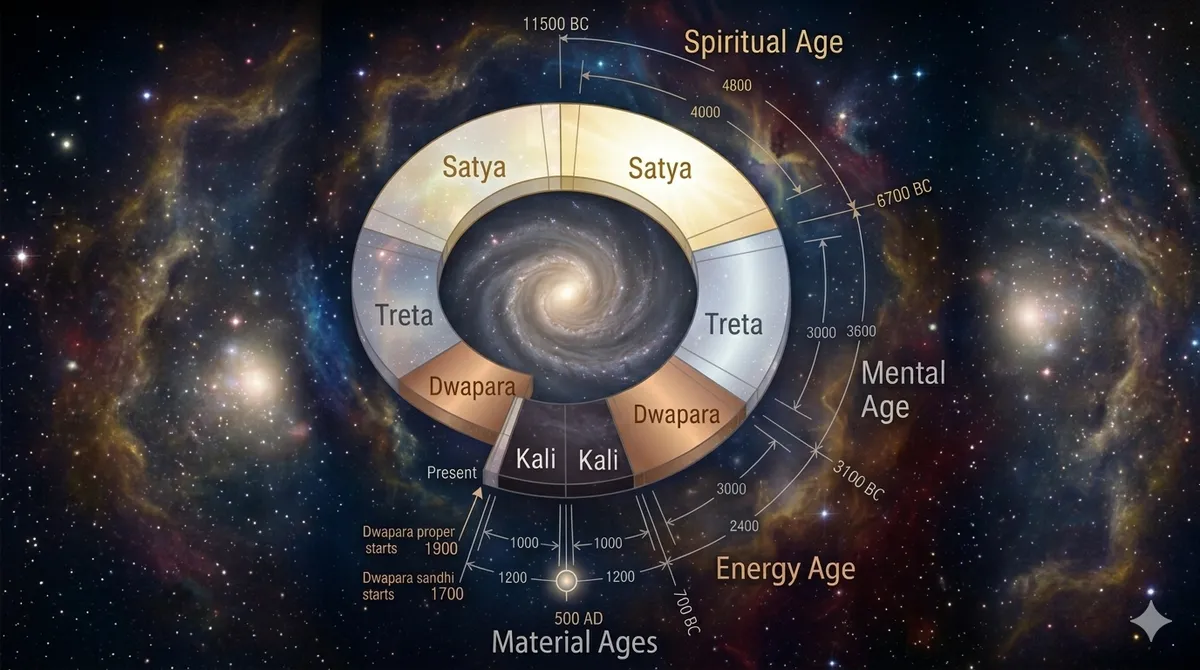
His corrected model proposes a complete yuga cycle of 24,000 years ,tied directly to an observable astronomical phenomenon: the precession of the equinoxes, which Sri Yukteswar attributed to our sun slowly orbiting a companion star over this vast period.
As our sun draws closer to this grand center of the galaxy (which he called Vishnu-Naabhi), human consciousness expands. As it moves away, consciousness contracts. The cosmic clock ticks not just in outer space — but within the minds and hearts of every human being.
The 24,000-Year Cycle at a Glance
Descending Arc (12,000 years — moving away from the galactic center):
Satya Yuga (4,800 yrs) → Treta Yuga (3,600 yrs) → Dwapara Yuga (2,400 yrs) → Kali Yuga (1,200 yrs)
Ascending Arc (12,000 years — moving toward the galactic center):
Kali Yuga (1,200 yrs) → Dwapara Yuga (2,400 yrs) → Treta Yuga (3,600 yrs) → Satya Yuga (4,800 yrs)
The lowest point of spiritual darkness: ~499 CE | The ascending arc began: ~499 CE | Kali Yuga ended: ~1699 CE
Where We Stand Right Now
According to Sri Yukteswar's calculation, the spiritual nadir,the very bottom of the cycle, occurred around 500 CE, the height of the Dark Ages. The long climb back upward began immediately. The Kali Yuga ended around 1699 CE, ushering in an ascending Dwapara Yuga. And Dwapara is the age of energy.
Look at what has unfolded since 1700: the discovery of electricity, electromagnetic forces, nuclear energy, the internet, quantum physics, all confirming that humanity's awareness has broken through the purely material surface to perceive the energetic, subtle layer of reality beneath. Writing in 1894, Sri Yukteswar actually predicted that energy would be discovered to underlie all matter, a prediction that predates Einstein's E=mc² by over a decade.
We are currently in the early-to-mid phase of ascending Dwapara Yuga. Think of it on a 24-hour clock: if the darkest hour of Kali Yuga was 6 o'clock, we are now approaching 8 o'clock — the light is growing, but the night has not fully passed. The horizon is brightening, but the darkness of what came before is still visible behind us.
Why Is Everything So Chaotic If We're Ascending?
This is the question that stirs the soul. If we're in an ascending age, if consciousness is actually expanding, then why does the world seem to be tearing at the seams?
The answer the yuga framework offers is profound: transition is inherently disruptive. When light returns to a room that has been dark for a very long time, the first thing it does is reveal everything that was hidden in the shadows, the dust, the disorder, the things that were pushed into corners and ignored.
The wars, the political chaos, the technological disruption, the crumbling of old institutions, these are not signs that we are falling. They are the symptoms of an old world order that was built on Kali Yuga consciousness — on separation, materialism, and fear — being exposed and dismantled by the rising light of Dwapara awareness.
Consider that in Kali Yuga, human beings were spiritually contracted: unable to perceive energy, unable to sense the interconnectedness of all life. Structures built on domination, rigid dogma, and separation from the divine were inevitable in that level of consciousness. As that consciousness expands in Dwapara, those structures don't simply update — they resist and then break.
We are not witnessing the end. We are witnessing the labor.
Technology, AI, and the Mirror of Dwapara
It is not coincidental that artificial intelligence, a technology that works at the level of energy patterns and information, not physical matter — has exploded into our world right now. It is quintessentially Dwaparan.
Dwapara Yuga is the age in which humanity learns to work with subtle forces, electricity, magnetism, radiation, now digital intelligence. The opportunities are extraordinary. The dangers are equally real. The yuga model doesn't promise that all Dwaparan discoveries will be used wisely, it simply tells us that this is the level of awareness the age makes available.
Our collective challenge is not to stop these developments, but to evolve our wisdom, our inner Dwaparan awareness — fast enough to match the power of what our outer technology is creating. This is the great invitation of our age.
What the Yugas Offer Us: Guidance and Hope
Perhaps the greatest gift of Sri Yukteswar's teaching is the way it reframes fear into meaning. Instead of asking "Why is all of this happening?" from a place of helplessness, the yuga framework offers the grounding question: "How am I called to show up in this particular moment of the great cycle?"
Sri Yukteswar himself emphasized that while yugas describe collective tendencies and the broad currents of history, individuals always retain the freedom to align with higher possibilities. The yuga is a wave — but you can choose how you ride it.
Some ways this wisdom can guide us right now:
✦ Release the story that the world is "broken." What looks like breaking down may be breaking through. The structures that are crumbling were built for a lower age of consciousness. Their collapse is sacred.
✦ Invest in your inner Dwapara. Dwapara expands awareness beyond the purely physical. Meditation, energy work, intuitive development, and contemplative practice are not retreats from the world — they are how you upgrade your consciousness to meet the demands of this age.
✦ Trust the arc. The lowest point has already passed — over 1,500 years ago. We are on the ascending arc. The trajectory is upward, even when individual moments feel dark.
✦ Seek unity beneath division. One of Sri Yukteswar's central missions was demonstrating the underlying unity of all spiritual traditions. Political and religious division are Kali Yuga residues. Dwaparan consciousness increasingly perceives what connects rather than what separates.
✦ Be a conscious participant. Understanding the yugas doesn't make us passive observers of fate. It makes us conscious co-creators within vast cosmic rhythms. Knowing the season, we can plant accordingly.
A Final Word: You Are Not Lost in History — You Are History
It is no accident that you are alive right now. In the great wheel of cosmic time, this transition between ages is one of the most significant and dynamic periods in thousands of years. The souls who incarnate during threshold times are — by spiritual tradition — those who chose to be here precisely because of the work that needs doing.
The fear, the uncertainty, the sense that everything familiar is shifting — these are real. But they are also the feeling of a world in the middle of waking up. The disorientation of dawn.
Sri Yukteswar saw this moment clearly, even writing in 1894. He closed his book noting that in this new age, "the world is reaching out for spiritual knowledge and men require loving help one from another." Over a century later, that sentence reads not as prophecy but as a description of this morning's news feed.
We are not at the end of the story. We are at the turning of the page.
Further Exploration
If this perspective resonates with you, we invite you to explore:
• The Holy Science by Swami Sri Yukteswar Giri
• Autobiography of a Yogi by Paramahansa Yogananda
• The Yugas by Joseph Selbie and David Steinmetz